
The Santoku knife has moved from traditional Japanese kitchens into homes and professional environments around the world. Its rise is not driven by trends, but by how effectively it solves everyday cooking tasks. As more people look for tools that improve efficiency without adding complexity, the Santoku has become a reliable choice.
What makes the Santoku knife so popular
The Santoku is not popular by accident. It addresses three key needs in the kitchen: control, efficiency, and versatility. These qualities explain why it has become a standard tool far beyond its origin.
Built for three core tasks
The name Santoku knife comes from Japanese words “San” (three) and “Toku” (virtues). These refer to the knife’s ability to handle slicing, dicing, and mincing.
Instead of switching between multiple tools, one Santoku can cover most preparation work. This simplicity is one of the main reasons cooks adopt it quickly.
Blade shape improves control
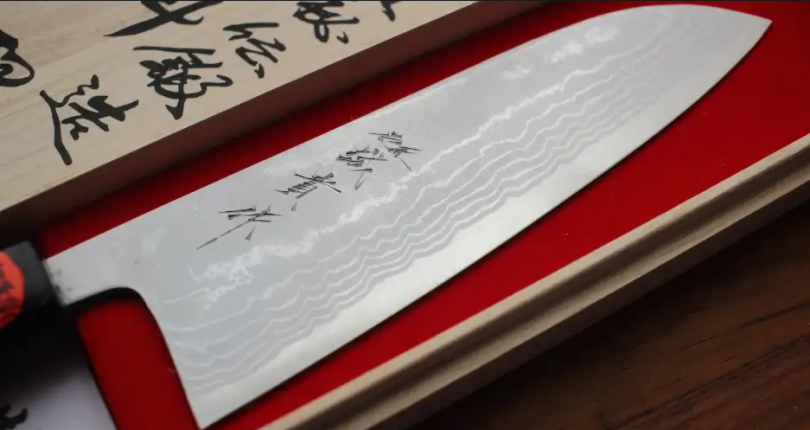
The Santoku has a distinct design that changes how it feels in use. It typically features a shorter blade, around 16–18 cm, a flat edge profile, and a rounded “sheep’s foot” tip.
This structure creates more contact with the cutting board and supports straight, stable cuts. Compared to larger Western-style knives, it reduces the need for a rocking motion and encourages precise up-and-down cutting.
The result is more predictable performance and improved control, especially for less experienced users.
Thinner blade means smoother cutting
Santoku knives are generally thinner and lighter than many alternatives. This reduces resistance when cutting.
In practice, this leads to less crushing of ingredients and cleaner slices. Vegetables retain their structure, and meat or fish can be cut with more accuracy.
For many users, this shift translates directly into better results with less effort.
Granton edge reduces sticking
Many Santoku knives feature small indentations along the blade, known as a Granton edge. These create air pockets between the blade and the food.
This reduces sticking during use, allowing ingredients to fall away more easily. The benefit is a faster workflow and fewer interruptions to clear the blade.
In daily cooking, this detail makes a noticeable difference.
Versatility without complexity
The Santoku sits between specialized knives and general-purpose tools. It is simple enough for everyday use, but efficient enough for demanding tasks.
It performs well when working with vegetables, boneless meat, and fish, while avoiding the need for complex techniques.
This balance makes it suitable for beginners, home cooks, and professionals who value speed and consistency.
Designed for modern cooking habits
Modern kitchens often demand speed and flexibility. Meals include more vegetables, preparation time is shorter, and workspace can be limited.
The Santoku supports these conditions. Its design allows for quick chopping, accurate portioning, and controlled cuts without excessive force.
This aligns with how people cook today, where efficiency and precision matter more than heavy-duty performance.
Easier to handle for most users
Practical factors also drive adoption. The shorter blade feels less intimidating, while the lighter weight reduces fatigue during longer preparation sessions.
The balanced design improves accuracy and makes the knife easier to control. For many users, the difference is immediate.
It simply feels more manageable than larger knives, which encourages consistent use.
Clean cuts improve food quality
One of the less discussed advantages is how cleaner cuts affect food quality. When ingredients are cut cleanly, their structure is preserved and cell damage is reduced.
This helps maintain moisture and freshness. Herbs stay intact longer, and vegetables are less likely to bruise.
The impact goes beyond convenience. It contributes directly to the final result on the plate.
A tool that becomes part of the cook
A knife is one of the most frequently used tools in any kitchen. When the size, steel, handle, and sharpness are properly matched, it becomes more than just a tool. It becomes an extension of the user’s hand.
In Japanese culinary philosophy, this connection is described as Jinba Ittai (人馬一体), meaning “person and horse as one body.” Applied to cooking, it reflects a state where the knife moves naturally with the cook, without resistance or hesitation.
When this connection is achieved, more attention can be placed on the ingredients themselves. The process becomes smoother, and the results improve.
For those exploring high-quality blades, selections like Japanese chef knives provide access to tools designed with this philosophy in mind. Within that category, options such as a Gyuto knife offer a more traditional Western-style profile, while the Santoku knife focuses on precision and efficiency in everyday tasks.
A broader shift in kitchen tools
The popularity of the Santoku knife reflects a broader change in how people approach cooking. Instead of relying on multiple specialized tools, many prefer a smaller set of highly effective ones.
This shift favors knives that deliver consistent results with minimal effort. The Santoku fits this requirement by combining control, versatility, and ease of use in a single design.
SharpEdge Shop positions itself within this space by offering a curated selection of high-performance blades. The focus is not only on providing tools, but also on educating cooks about the impact a well-designed and properly maintained knife can have on food preparation.
A sharper, better-balanced knife does not just make cutting easier. It improves texture, preserves ingredients, and supports more precise cooking.
The goal, as emphasized by SharpEdge Shop, is to help users develop their own connection with their tools. When that happens, the knife becomes a natural extension of the cook’s movement, aligning with the concept of Jinba Ittai.
Why the Santoku remains relevant
The Santoku knife continues to gain popularity because it solves real problems without adding complexity. It simplifies preparation, improves control, and supports better results across a wide range of ingredients.
Its design reflects how people cook today: efficiently, with attention to detail, and with tools that support rather than complicate the process.
For many, it becomes the one knife they reach for most often. That consistency is what ultimately defines its place in modern kitchens.